


In Japan, movement through public space is rarely chaotic. Even in the busiest train stations, where thousands of people pass through every hour, there is a sense of order that feels almost invisible. This order is not enforced loudly, nor is it explained in detail. Instead, it is guided by subtle visual cues—lines on the ground, arrows pointing the way, markings that suggest where to stand, wait, or walk. These signs form what might be called a “quiet language” of spatial courtesy, shaping behavior without the need for constant instruction. Like an unspoken agreement shared among strangers, they help people move together smoothly through shared environments.
From Lines on the Ground to Social Understanding
The origins of this system lie not in a single rule, but in a long-standing cultural emphasis on harmony and consideration for others. As Japan’s cities grew and public transportation became more complex, the need for efficient movement increased. Rather than relying only on announcements or strict enforcement, designers began using visual guidance to influence behavior. Over time, these markings became familiar, and people learned to follow them naturally.
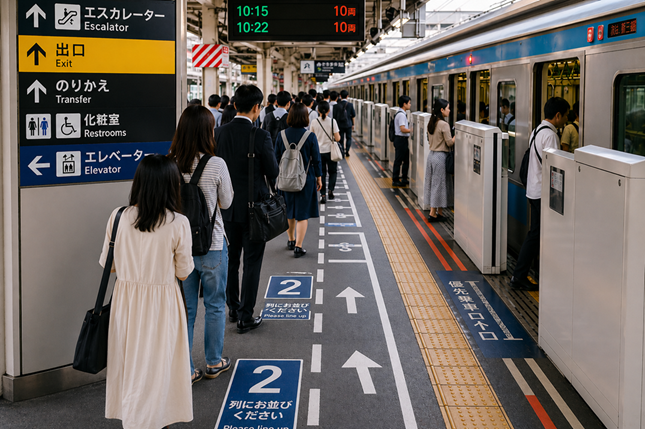
At train stations, for example, lines indicate where passengers should queue while waiting for a train. Arrows show the direction of flow on staircases, helping prevent congestion. Platforms often have designated boarding areas, encouraging passengers to line up in an orderly fashion. These systems are simple, but their effectiveness depends on shared understanding. The markings themselves do not force compliance—they rely on the willingness of individuals to participate in a collective rhythm.
This reflects a broader idea in Japanese society: that public space is something to be shared, and that individual behavior should support the comfort of others. The result is a kind of coordination that feels almost intuitive.
Designing for Movement and Comfort
What makes Japan’s spatial guidance system especially interesting is its attention to detail. The placement, color, and shape of markings are carefully considered. Yellow tactile paving, for instance, serves both as a guide for visually impaired individuals and as a directional cue for others. Floor markings near escalators indicate where to stand, while leaving space for those who wish to walk. Even in crowded areas, these small design choices create a sense of flow.
This approach can be seen as a form of design that communicates without words. Instead of telling people what to do, it suggests behavior through visual structure. In doing so, it reduces stress and confusion, especially in environments where many people are moving at once.
For language learners, this system offers a different way of understanding communication. Not all messages are spoken or written. Some are embedded in space itself, shaping how people act and interact. Observing these patterns can provide insight into how Japanese society balances individual freedom with collective responsibility.
Fukuoka’s Everyday Rhythm
In Fukuoka, this culture of spatial courtesy can be experienced in a more relaxed but equally clear form. Around major hubs such as Hakata Station, floor markings guide passengers through ticket gates, platforms, and transfer routes. Compared to Tokyo, the pace may feel slower, but the same principles apply. People line up neatly, follow directional arrows, and move with awareness of those around them.
What makes Fukuoka distinctive is its balance between structure and warmth. While the visual systems are present, interactions often feel more personal. Station staff may offer guidance with a friendly tone, and passengers are generally attentive without appearing rushed. This creates an environment where order and ease coexist.
In shopping streets and underground passages, similar patterns appear. Arrows indicate walking directions, and designated spaces help organize movement during busy times. Yet the atmosphere remains approachable, reflecting the city’s reputation for openness and friendliness. For students living in Fukuoka, these spaces offer a comfortable introduction to Japanese spatial norms—structured, but not overwhelming.
Beyond Efficiency: A Culture of Consideration
It would be easy to see these systems as purely functional, designed only to improve efficiency. However, their deeper significance lies in what they reveal about social values. Following a line on the ground is not simply about convenience; it is a small act of consideration. By standing where others expect, by moving in the indicated direction, individuals contribute to a shared sense of ease.
This idea extends beyond transportation. It can be seen in how people arrange themselves in elevators, how they leave space for others on sidewalks, and how they avoid blocking entrances. These behaviors are rarely discussed explicitly, yet they form an important part of everyday life.
For visitors, this may take some time to notice. At first, the markings may seem like simple instructions. But with attention, they reveal a broader pattern—a way of thinking about space that prioritizes mutual awareness.
A Language Without Words
The culture of road markings and spatial guidance in Japan shows how communication can exist without speech. Lines, arrows, and subtle signs become a shared language, one that organizes movement while preserving a sense of calm.
In a world where public spaces are often crowded and fast-paced, this approach offers an alternative model. It suggests that order does not always require strict control, and that harmony can emerge from small, collective actions.
For students studying in Japan, learning this “language” can be as important as learning vocabulary or grammar. It is a way of understanding how society functions at a practical level, and how respect for others is expressed in everyday behavior.
In the end, these lines on the ground do more than guide movement. They reflect a cultural idea—that even in the simplest actions, there is an opportunity to consider others. And in following them, people participate in a shared rhythm that makes public life just a little smoother for everyone.