



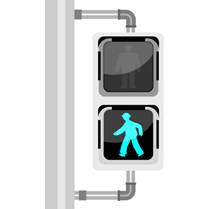
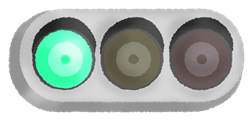
Look at the traffic light ahead: Is it green or blue?
If you were walking around the streets of Fukuoka and asked a local, “What color is the ‘Go’ signal?”, they would instantly answer without hesitation: “Ao” (青 — Blue)!
Wait a second… blue? If you take a closer look at the light, it is clearly a bright shade of green!
In English and most Western languages, this is strictly called a “Green light.” In fact, if you say “Blue light” in English, people will usually picture the flashing siren lights on a police car or an ambulance.
So why on earth do Japanese people call green traffic lights “blue”? Let’s uncover this fun linguistic mystery!
1. The History: When “Blue” Covered “Green”
To solve this cultural puzzle, we have to travel back in time through the history of the Japanese language.
In ancient Japan, there were originally distinct words for only four primary colors: White (白), Black (黒), Red (赤), and Blue (青). Back then, the word “Ao” (青) had a very broad definition—it covered the spectrum of both blue and green!
Even today, this historical language habit lives on in everyday Japanese vocabulary:
- 青葉 (Aoba): Fresh green leaves
- 青りんご (Ao-ringo): Green apple
- 青虫 (Aomushi): Green caterpillar
2. Why “Green Lights” Became “Blue Lights” in Japan
When Japan installed its first official automatic traffic light in 1930, official government documents actually listed it as “Midori-shingo” (緑信号 — Green signal).
However, because the cultural habit of referring to green things as “Ao” was so deeply rooted, newspapers and everyday citizens naturally began calling it “Ao-shingo” (青信号 — Blue signal) instead. This nickname became so overwhelmingly popular across the country that the government eventually threw in the towel and officially changed the legal term to “Ao-shingo” in 1947!
3. Modern Technology
International traffic laws mandate a strict color scheme: Red, Yellow, and Green. So how did Japan stay compliant without abandoning the beloved name “Ao-shingo”? Instead of changing the name back, Japanese engineers adjusted the physical light itself!
Modern Japanese traffic signals use a special shade of blue-green LED. By pushing the green tint as close to blue as international safety regulations physically allow, they created a light that satisfies both global standards and local tradition!
Summary
Language and our perception of color are deeply connected to history and culture.
When you visit Japan, take a moment to look closely at the traffic lights when crossing the street. Does the light look green to you? Or does it look a little more blue?
If your country has any interesting color words with a fascinating history behind them, we’d love to hear about them!
Let’s learn Japanese language and culture together at NILS!
⇓Follow us on Instagram for more about school life in Japan⇓